Oregon’s trucking industry plays a key role in keeping the economy moving. Close to 80% of Oregon communities depend solely on trucks to deliver everyday essentials, from food to medical supplies. Other industries rely on trucks to transport not only their final products, but also the materials and equipment needed to manufacture goods and maintain their businesses.
Trucking in Oregon
Almost all the products you use every day have traveled by truck at some point in time. Most products start with raw materials that are transported to a processing facility. From there, they may have been transported to an assembly plant, a distribution facility, and then to your local store or front door.
Without trucks, you probably wouldn’t get your morning coffee, have shoes to wear, milk to drink (from a cow or a nut) or have a house to live in! Trucking is a vital part of our economy in the U.S. and in the state of Oregon.
Take a look at some fast facts for Oregon’s trucking industry. Some you may already be aware of. Others may come as a surprise.
Oregon is #1...in Trucking Taxes & Fees
Oregon remains the most expensive state to operate a truck based on taxes. These taxes are in addition to regular business taxes that trucking companies also pay.
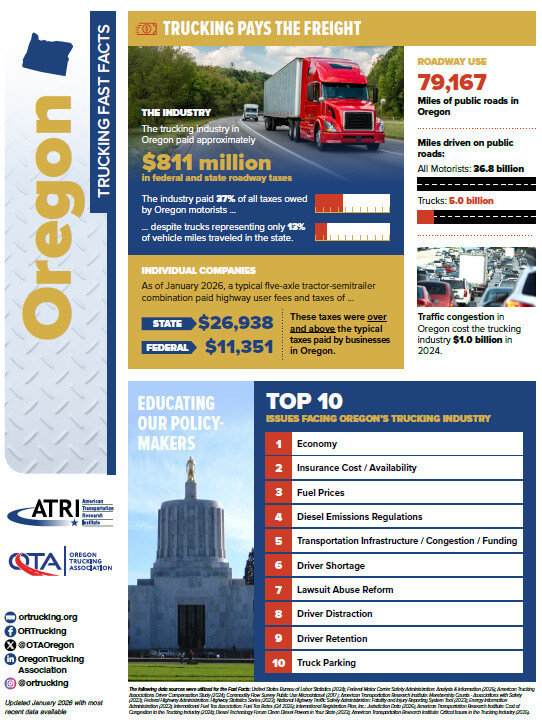
As of 2026 Oregon trucking companies pay $38,289 in state and federal highway user taxes each year.
- State: $26,938
- Federal: $11,351
To put that into perspective, here are the states that round out the top 5:
- #2 – Connecticut: $30,721
- #3 - California: $29,875
- #4 - Illinois: $26,225
- #5 – Pennsylvania: $26,141
The least expensive state to operate a commercial heavy vehicle in terms of trucking-specific taxes is Alaska at $13,134. Our neighbors also pay less. Washington State comes in at #8 with $22,816, while Idaho is #19 with $19,856.
Just the Facts
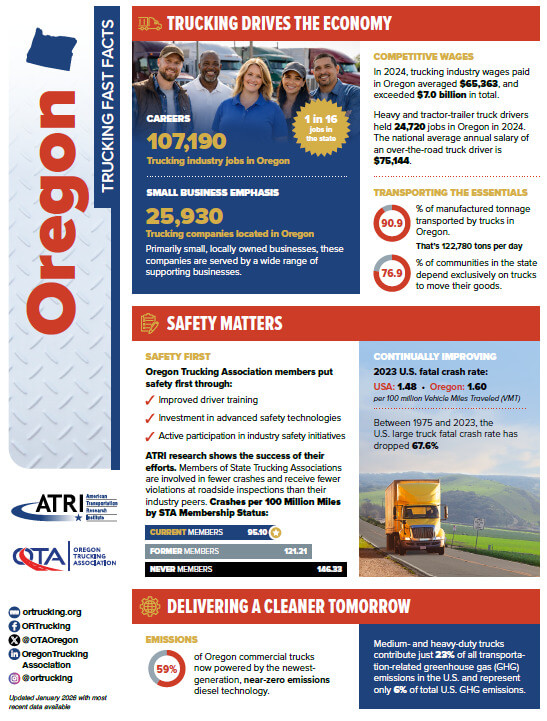
Every year, the American Transportation Research Institute (ATRI) develops a set of fast facts for each state. The latest set of Oregon Trucking Fast Facts is below.
Key Takeaways:
- There are 107,190 trucking industry jobs in Oregon, with an average wage of $65,363 and accounting for 1 in 16 jobs in the state.
- 59% of Oregon commercial trucks now powered by the newest generation, near-zero emissions diesel technology.
- 90% of manufactured tonnage transported by trucks in Oregon.
- 76.9% of communities in the state depend exclusively on trucks to move their goods.
Bottlenecks Cost Billions
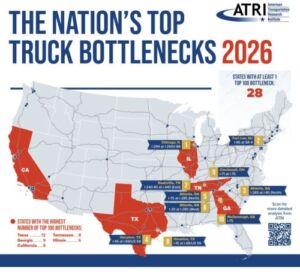 Oregon is now home to THREE of the top 100 worst freight bottlenecks in the country, with congestion costing the Oregon trucking industry $1.0 billion a year. Overall, congestion cost America's trucking industry $108.8 billion each year.
These are the spots in Oregon that can bring freight movement to a standstill:
- #27: I-5 @ I-84 (Portland)
- #39: I-5 @ the Columbia River (Portland)
- #78: I-5 @ I-205 South (Portland)
The Push for Electric Vehicles: Facts & Figures
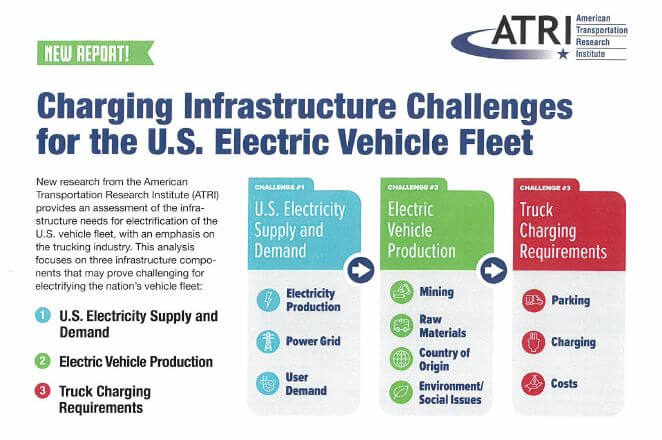
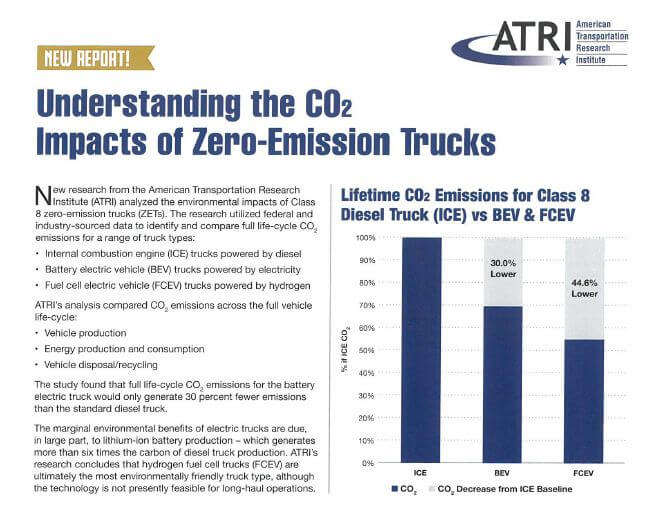
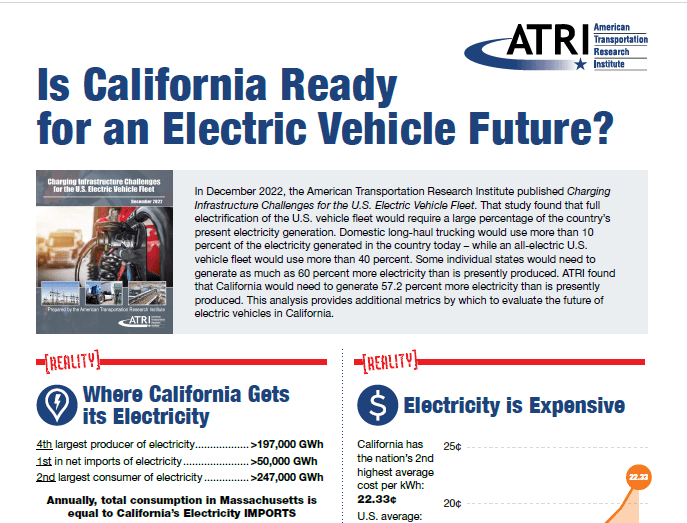
ATRI has issued reports related to charging infrastructure challenges for electric vehicle fleets and the CO2 impacts of zero-emission vehicles. They are also taking a closer look at California's preparedness. Click on the graphics below for the full reports.
Key Takeaways:
- Full electrification of the U.S. vehicle fleet would require a large percentage of the country's existing electricity generation
- Some states (CA, NM, MO and others) would need more than 50% of current electricity generation to meet electric vehicle travel needs
- Class 8 Costs: Diesel vehicle - up to $150,000; Battery electric vehicle - up to $450,000; Fuel cell electric vehicle - $200,00 - $600,000
- There currently is no U.S. network where over-the-road trucks can stop for rest breaks and recharging at the same time
Careers in Trucking
While the most visible trucking industry job is that of a driver, there are a lot of other positions that keep the industry moving. Necessary skill sets are as diverse as the people who make up the industry. Technology also continues to transform trucking, requiring innovative and forward-thinking team members. If you're looking for career path that offers plenty of opportunities, consider the trucking industry and these positions - just to name a few:
Truck Driver
Diesel Technician
Mechanic
Maintenance/Shop Manager
Director of Safety & Compliance
Warehouse/Plant/Facilities Manager
Dispatcher/Driver Manager
Transportation/Fleet Supervisor
Logistics Manager/Planner
Operations Manager
Trainer/Instructor
Brokerage Specialist
IT Specialist
Human Resources
Liability/Claims Manager
Sales Professional
Marketing Specialist
Business Development
Have questions about the trucking industry? Contact us at info@ortrucking.org.